Skill is no longer the price of admission
For a long time, a person's value was measured by what they knew how to do with their hands. The precision of the gesture, the depth of experience, the number of years spent mastering a field. It was the only metric that truly mattered.
That is no longer true. And this isn't a gentle evolution—it's a tipping point.
Today, people without technical training are building tools that generate revenue. Non-designers are producing interfaces that professionals would have spent weeks designing. People who do not know how to code are launching apps. People who cannot draw are creating visual identities.
This is not an anomaly. It's not a trend. It's the new world we live in.
And if you work in a creative or technical field, you may have already felt it, without necessarily naming it: something has changed. The rules have changed.
The wall is coming down
Just five years ago, building software took years. Understanding architectures, mastering frameworks, learning syntax, debugging cryptic errors. Code was a wall. Behind that wall were the creators. In front of it were everyone else. That wall no longer exists.
Today, solo entrepreneurs launch profitable SaaS businesses without ever writing a line of code. Content creators build complex internal tools without hiring a developer. Shop owners create mobile apps for their stores without knowing what a framework is.
Why? Because they learned one single thing: knowing how to ask.
They describe what they want. The tool builds it. They correct. They refine. They iterate. Code is generated, not written. Interfaces are produced, not drawn. The solution is conversational, not technical.
This is Vibe Coding: coding by intuition, by description, by dialogue. You no longer master the language. You master the intent.
Platforms like Lovable.dev allow you to build complete applications from simple descriptions. Replit integrates an AI agent that codes for you. Bolt.new by StackBlitz generates full-stack projects in a few sentences. v0.dev from Vercel turns prompts into React interfaces. Cursor and Windsurf are reinventing the code editor as a conversational assistant.
These are not toys. People are making real money with tools built this way. Not just pocket change. Substantial, recurring, sometimes life-changing revenue.
Independent creators and solopreneurs are now building multiple viable micro-SaaS products in weeks using tools like Lovable and Cursor, reaching thousands of dollars in monthly recurring revenue without raising capital or hiring engineering teams. Not by spending years mastering framework internals, but by learning to orchestrate, iterate, and judge.
Pieter Levels, a pioneer of the indie hacker movement, has built apps generating hundreds of thousands of dollars annually with a minimal tech stack and a rapid iterative approach. His model isn't technical perfection. It's the speed of testing.
It might feel unfair. The person who spent ten years learning their craft looks at this and may legitimately feel cheated. But unfairness doesn't erase reality. This is the new world.
Design without the eye
The same phenomenon applies to design. For decades, creating an elegant interface required a trained eye, years of practice, and deep visual culture. Design was a gift, a discipline, a rare know-how.
Today, tools like Figma with its AI features, Canva, Midjourney, DALL-E or Recraft allow anyone to produce visuals, mockups, and professional-grade illustrations without ever opening advanced design software.
But the real shift isn't the image quality. It's that the technical barrier has disappeared.
A person who knows how to describe what they feel, what's wrong, what they want to convey, can get a visually convincing result in minutes. They don't know the rules of visual hierarchy. They don't know why a composition works. But they know how to ask, and they know how to judge when it's good.
Design is becoming less about technique and more about expressed taste. Clarified vision. The ability to say: "That's not quite it, it's more like this."
And in this new world, the one who knows how to say what they want moves faster than the one who knows how to do it but cannot express themselves.
What is happening in companies
This shift doesn't just affect independent entrepreneurs or solo creators. It is redrawing the very culture of companies.
Recruiters no longer just ask:
- Which languages do you master?
- How many years of experience do you have with this framework?
They now ask:
- How do you use AI in your workflow?
- What tools allow you to move faster?
- How do you iterate on an idea in a day instead of a week?
This isn't a marginal HR trend. It's a paradigm shift. Companies have understood that raw skill is no longer enough. They are looking for hybrid profiles: people who have the technical or creative know-how, and who know how to multiply it with the right tools.
A developer who codes fast but refuses to use Cursor or GitHub Copilot is seen as a bottleneck, not an asset. A designer who draws every element by hand when AI could generate ten variants in minutes is seen as someone who works slowly, not someone who works well.
Companies are no longer looking for the best craftsman. They are looking for the best multiplier. The one who understands that value is no longer in the gesture alone, but in the ability to produce more value in less time, with more iterations, more tests, more learning.
And those who don't understand this shift find themselves in a precarious situation. Not necessarily fired right away. But sidelined from strategic projects, excluded from fast-moving teams, relegated to the repetitive tasks no one else wants to do. Obsolescence isn't always brutal. It is often silent.
It's not that companies are cruel. It's that they are pragmatic. Faced with a competitor who ships in two days what takes you two weeks, the choice isn't moral. It's economic.
What is not changing (yet)
We must stay realistic about current limitations. What I describe here doesn't apply to everything.
Some disciplines remain deeply technical and difficult to automate. The complex architecture of a large-scale distributed system still requires a profound understanding of constraints. Medicine cannot be boiled down to a prompt, even if AI assists with diagnostics. Critical engineering—aeronautics, nuclear, infrastructure—requires rigorous validations that no tool can replace.
In these fields, technical competence remains non-negotiable. Know-how is not a bonus. It's a legal and safety requirement.
But what strikes me is that the boundary is receding. What was considered "too complex for AI" two years ago is now partially automated. And that boundary will keep receding.
This isn't a reason to ignore the shift. It's a reason to position yourself correctly: master your field where it is still indispensable, and learn to multiply your impact where tools allow it.
Two worlds coexisting
There are now two types of creators moving fast. And they don't have much in common, except for one thing: they use the tools that multiply their capacity.
The first is the competent professional who adapts. Imagine two designers with exactly the same skill level. The same eye for detail, the same visual culture, the same high standards.
The first works as they did five years ago. Every exploration takes time, every variation is hand-drawn, every piece of research starts from scratch.
The second keeps the same high standards, but uses AI to explore more directions, generate variations, speed up research, and prep prototypes. They do not delegate their judgment; they delegate friction.
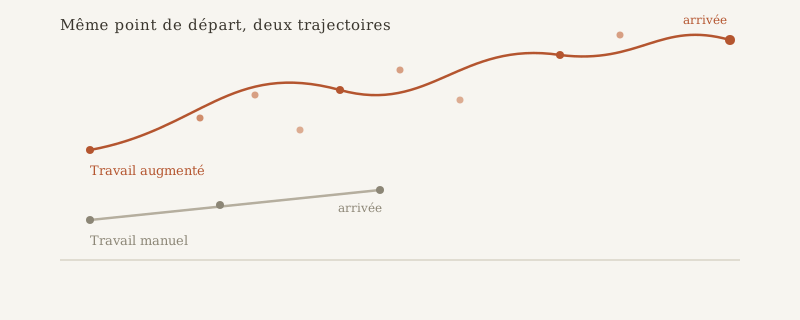
After a month, both still possess the same talent. But one has tested ten times more ideas, corrected ten times earlier, and learned ten times faster from their mistakes.
It's not a story about talent. It's a story of iteration speed.
The second type of creator is the one who lacks the talent. Lacks the training. Lacks the years of experience. But who has the audacity to ask and the clarity of thought. And who, armed with the same tools, produces fast, tests fast, and learns fast.
These two worlds now coexist. And the professional who refuses to adapt ends up stuck between the two: too slow to keep up with augmented peers, and too rigid to compete with the agility of new entrants.
What AI cannot replace
Let's be clear on one point, because this is often where confusion sets in: AI provides no taste, no instinct, no point of view. It amplifies what already exists.
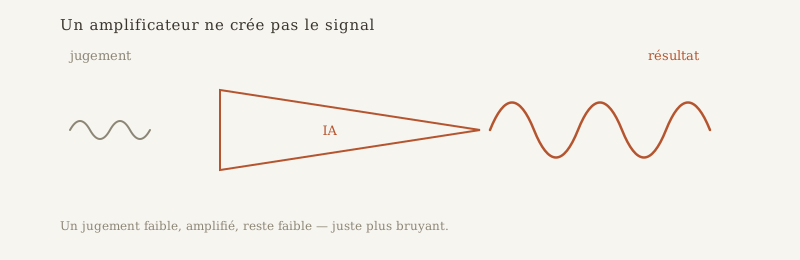
A mediocre creator using AI produces mediocre work, in higher quantities, and much faster. An excellent creator using it well accesses a broader and faster version of their own thought process.
You can verify it yourself: give the same tool to two people of different skill levels, on the same project. The quality gap does not shrink. It just becomes obvious faster.
But there is a new nuance: give a powerful tool to someone without technical skills but with good judgment, and to someone with technical skills but without clarity of thought. The result might surprise you.
Technical skill remains valuable. But it is no longer the only filter. The ability to reason, structure, judge, and ask becomes an equally powerful filter—sometimes even more powerful.
The real risk is not what we think it is
Many professionals worry about being replaced by AI. It's an understandable fear, but it often targets the wrong threat.
The danger isn't that AI will replace competent people. The danger is that it exposes the gap between those who adapt and those who refuse, and that this gap widens much faster than imagined.
But there is another gap, just as real: the one between professionals who master their craft and non-professionals who, armed with the right tools, create viable solutions without that mastery.
This is not a threat of direct replacement. It's a redefinition of the playing field. The barriers to entry are collapsing. What used to separate the "creator" from the "consumer" is becoming porous. And those who rest on their technical laurels without adding speed and adaptability risk finding themselves stuck between two worlds.
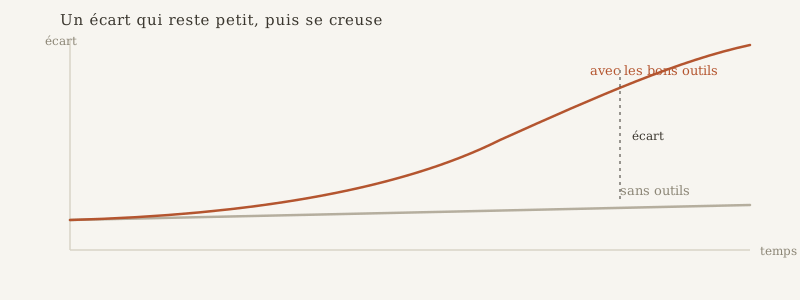
At first, the difference is almost invisible. A few hours saved each week, a few extra iterations. But this advantage compounds. It accumulates project after project, until it becomes a gap that is near impossible to close.
Refusing these tools out of principle, or suspicion, is no longer a neutral choice. It means accepting to work slower, explore fewer directions, and stay out of a rhythm that others have already quietly adopted.
This isn't about following a trend. It's about staying in the race, on your own terms.
The augmented creator
Tomorrow's creator won't just be the one who masters their craft, but the one who also knows how to augment their capabilities with the right tools.
A designer or developer who perfectly understands their field, and who also knows how to use AI to explore ideas, generate variants, speed up research, or prepare prototypes, will have a real edge over the one who does everything manually.
But this edge isn't just about internal productivity anymore. It's an issue of positioning. The augmented creator doesn't just produce faster. They understand the new language of creation. They know that non-technical people build profitable tools, that non-designers produce convincing visuals—and they also know why their own eye remains valuable.
It's not the tool that makes the difference. It's not the craft alone, either. It is the combination of both: a solid foundation of skill, set into motion by tools that multiply it, in a world where the technical barrier is no longer a filter.
What is left to do yourself
None of this excuses you from developing true know-how. This might be the most important point in this essay: AI does not fill a lack of competence, it multiplies the competence you already have.
If you haven't yet built your eye, your logic, your sense of detail, AI won't do it for you. It will simply give you more material to judge, without giving you the means to judge it well.
Those who will fare best are therefore not those who simply learn to use the right tools. They are those who, in addition to that, continue to build a true perspective on their craft, project after project, decision after decision.
The tool advances fast. Judgment, however, always builds slowly.
And precisely for that reason, it will become increasingly invaluable.
The future belongs neither to technicians alone, nor to intuitives alone. It belongs to those who can articulate both: the clear reasoning and the tool that accelerates it. Skill is no longer the price of admission. But it remains the ultimate multiplier.
Read Next